Ever brew a cup of coffee that’s… well, just meh? It’s not terrible, but it’s not great either. It might be watery, a bit bland, or just missing that satisfying punch. The good news is, you’re not doomed to a life of mediocre coffee. The secret to unlocking a consistently delicious cup lies in learning How To Adjust Coffee Strength Settings, and it’s easier than you think. Whether you’re working with a high-tech espresso machine or a simple drip brewer, you have more control over your final cup than you realize. Think of this guide as your personal barista training session. We’re going to demystify the dials, buttons, and techniques so you can become the master of your morning brew.
Why a Dedicated Coffee Maker is Your First Upgrade
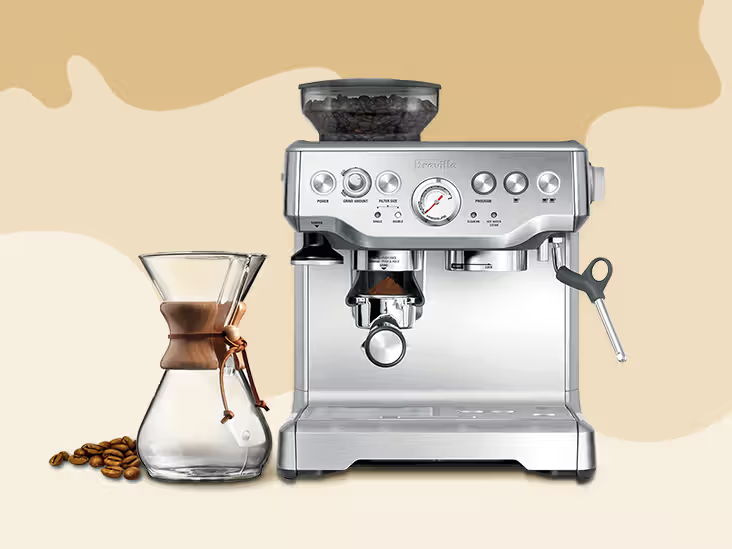
Before we dive into the settings, let’s talk about the hardware. You might ask, “Why can’t I just use instant coffee?” Well, you can, but you’d be missing out on a world of flavor, aroma, and ritual. A dedicated coffee maker isn’t just an appliance; it’s a tool for transformation. It takes humble roasted beans and, through a precise application of water and heat, turns them into liquid gold.
The key benefit is consistency and control. A quality coffee maker gives you a reliable baseline, allowing you to make small, intentional changes to fine-tune your brew. It empowers you to move from being a passive coffee drinker to an active, engaged brewer.
A Quick Tour of the Coffee Maker Universe
The term “coffee maker” covers a lot of ground. Each type has its own personality and method for extraction. Understanding your machine is the first step to mastering it.
- Drip Coffee Makers: The workhorse of many American and European kitchens. They’re automated, great for brewing multiple cups, and incredibly user-friendly. They work by dripping hot water over a bed of coffee grounds in a filter.
- Espresso Machines: For those who crave intense, concentrated coffee shots. These machines use high pressure to force hot water through a tightly packed “puck” of finely-ground coffee. They range from super-automatic (press a button) to fully manual (you’re the pilot).
- Pod Machines (e.g., Keurig, Nespresso): The champions of convenience. They use pre-packaged capsules for a lightning-fast, mess-free brew. While they offer less control, there are still tricks to tweak the strength.
- French Press: A beautifully simple, manual method. Coffee grounds steep directly in hot water and are then separated by plunging a mesh filter. This method gives you total control over the core variables.
The Ultimate Guide: How to Adjust Coffee Strength Settings
Alright, let’s get to the main event. Regardless of your machine, coffee strength is governed by three universal pillars. Master these, and you’ll master your coffee. I call them the “Big Three”: The Ratio, The Grind, and The Time.
The Big Three: Your Brewing Foundation
Think of these as the primary colors of coffee brewing. By mixing them in different amounts, you can create any shade of flavor you desire.
- The Coffee-to-Water Ratio (The Dose): This is the most fundamental setting of all. It’s simply how much coffee you use for a certain amount of water. A “stronger” coffee typically has more coffee grounds per unit of water.
- The Golden Rule: A great starting point for drip or French press is a 1:16 ratio. That means 1 gram of coffee for every 16 grams (or milliliters) of water.
- Want it stronger? Try a 1:14 or 1:15 ratio.
- Want it milder? Try a 1:17 or 1:18 ratio.
- Pro Tip: A simple kitchen scale is the single best investment you can make for better coffee. Stop guessing with scoops!
- The Grind Size: This is the gatekeeper of flavor. The size of your coffee grounds determines how quickly water can extract the flavor compounds.
- Fine Grind: More surface area, like sand. Water passes through slowly, extracting a lot. Go too fine, and you get a bitter, harsh, over-extracted taste.
- Coarse Grind: Less surface area, like gravel. Water passes through quickly, extracting less. Go too coarse, and you get a sour, weak, under-extracted taste.
As my friend Isabella Rossi, a certified Q Grader and barista trainer, always says, “Most beginners focus only on the machine’s buttons. But real control starts before the water even heats up. A consistent, adjustable grind is where the magic truly begins.”
- The Brew Time (Contact Time): This is how long your coffee and water are in contact. A longer brew time generally leads to a stronger, more extracted coffee. A shorter time results in a lighter brew. For drip and espresso machines, this is often linked to grind size—a finer grind will naturally slow the water down, increasing the brew time.
Applying the Principles to Your Machine
Now let’s see how the Big Three apply to different types of brewers.
Drip Coffee Makers
Many drip machines have a “Strong” or “Bold” setting. So, what does the ‘strong’ button actually do?
In most cases, it doesn’t add more coffee. Instead, it pulses the water or releases it more slowly. This increases the contact time between the water and the grounds, leading to a higher extraction and a bolder-tasting cup.
- Your Real Controls:
- Ratio: You control this 100%. Use a scale to measure your beans and water. This is the #1 way to adjust strength.
- Grind: Use a quality burr grinder. If your coffee is weak, try a slightly finer grind. If it’s bitter, go a little coarser.
Espresso Machines
With espresso, you’re chasing a balanced shot, and the adjustments are more sensitive.
- Your Real Controls:
- Dose: The amount of coffee in your portafilter basket. More coffee = a stronger potential shot.
- Yield: The amount of liquid espresso in your cup. A “ristretto” shot has a smaller yield (e.g., 1:1 ratio) and is very intense. A “lungo” has a larger yield (e.g., 1:3 ratio) and is milder.
- Grind: This is your main dial for taste. You’ll make tiny adjustments to your grind to get the perfect shot time (usually 25-30 seconds). Check out our [deep dive into espresso extraction] for more.
Pod Machines
Your control here is limited, but not zero.
- Your Real Controls:
- Cup Size: This is your ratio control. Brewing a smaller cup size with the same pod will result in a more concentrated, stronger drink.
- “Strong” Button: Like drip machines, this usually slows the brewing process for more extraction.
- Pod Selection: Choose pods labeled “Intense,” “Bold,” or with a higher intensity number. They often use a darker roast or a finer grind inside the pod.
French Press & Pour-Over
These manual methods put you in the driver’s seat.
- Your Real Controls:
- Ratio: You measure the coffee and water, giving you complete control.
- Grind: A coarser grind is standard for French press to avoid sediment.
- Steep Time: This is your primary strength dial for French press. A standard time is 4 minutes. Want it stronger? Try 5 minutes. Weaker? Try 3.
Choosing a Machine That Puts You in Control
As you can see, the ability to how to adjust coffee strength settings is often tied to the quality and type of your machine. If you’re feeling limited by your current setup, it might be time for an upgrade. A machine with manual controls, or a high-quality grinder, can be a game-changer, giving you the precision needed to dial in that perfect cup. Investing in equipment that allows for fine-tuning the grind and water temperature will elevate your coffee experience from a daily routine to a delightful craft.
|
Our Picks for the Best Coffee Maker in 2026
As an Amazon Associate, we earn from qualifying purchases.
|
||
| Num | Product | Action |
|---|---|---|
| 1 | BLACK+DECKER 12-Cup Coffee Maker with Easy On/Off Switch, Easy Pour, Non-Drip Carafe with Removable Filter Basket, Vortex Technology, Black |

|
| 2 | BLACK+DECKER 12-Cup Digital Coffee Maker, Programmable, Washable Basket Filter, Sneak-A-Cup, Auto Brew, Water Window, Keep Hot Plate, Black |
|
| 3 | BLACK+DECKER 12-Cup Digital Coffee Maker, Programmable, Washable Basket Filter, Sneak-A-Cup, Auto Brew, Water Window, Keep Hot Plate, Black |
|
| 4 | Keurig K-Express Single Serve K-Cup Pod Coffee Maker, 3 Brew Sizes, Strong Button Feature, 42oz Removable Reservoir, Black |
|
| 5 | Nespresso Vertuo Pop+ Coffee and Espresso Maker by De\'Longhi, Samra Origins by The Weeknd Vertuo Buna Yellow Aeroccino3 milk frother |
|
| 6 | Mr. Coffee Black Coffee Maker, 12 Cups, with Auto Pause and Glass Carafe, Perfect for Home and Office Use |
|
| 7 | Amazon Basics Coffee Makers, 12-Cup Coffee Machines with Reusable Filter, Coffee Pots, Black & Stainless Steel |
|
| 8 | Keurig K-Duo Hot & Iced Single Serve & Carafe Coffee Maker, MultiStream Technology, 72oz Reservoir (Gen 2) |
|
| 9 | Mini Hot and Iced Coffee Maker Single Serve, for K Cup and Ground, 6 to 14 Oz Brew Sizes, with Recipe Book, for Home, Travel, RV, Office and Dorm, Classic Black (2.0 Version) |
|
| 10 | BLACK+DECKER 12-Cup Coffee Maker with Easy On/Off Switch, Easy Pour, Non-Drip Carafe with Removable Filter Basket, Vortex Technology, Black |
|
Pro Tips to Keep Your Brew Game Strong
Once you’ve started to master your settings, a few extra habits can make all the difference.
- Use Fresh Beans: Coffee is a fresh product. Beans lose their vibrancy weeks after roasting. Buying from a local roaster and using them within a month will dramatically improve your flavor.
- Grind Right Before Brewing: Pre-ground coffee goes stale incredibly fast. Grinding just before you brew preserves the delicate aromatic oils. Our [guide to the best burr grinders] can help you choose the right tool.
- Use Filtered Water: Your coffee is over 98% water. If your tap water tastes off, so will your coffee. Use a simple carbon filter pitcher for a clean, neutral base.
- Keep It Clean: Old coffee oils build up and turn rancid, making your coffee taste bitter and muddy. Regularly clean and [descale your coffee maker] according to the manufacturer’s instructions.
Frequently Asked Questions (FAQ)
Q: What is the best coffee-to-water ratio for strong coffee?
A: A common starting point for a stronger brew is a 1:15 ratio (1 gram of coffee to 15 grams of water). You can go as low as 1:12 for a very robust cup, but be careful of over-extraction which can lead to bitterness.
Q: Does a finer grind make coffee stronger?
A: Yes, to a point. A finer grind increases the surface area of the coffee, which allows water to extract more flavor and dissolved solids, resulting in a stronger-tasting cup. However, if you grind too fine, you risk clogging your machine or creating a bitter, unpleasant taste.
Q: Why does my coffee taste weak even on the ‘strong’ setting?
A: This usually comes down to one of three things: an incorrect coffee-to-water ratio (you’re not using enough coffee grounds), a grind that is too coarse, or beans that are old and stale. Try increasing your coffee dose first.
Q: Is dark roast coffee stronger than light roast?
A: It depends on what you mean by “strong.” Dark roasts have a stronger, bolder, and more “roasty” flavor, but they actually contain slightly less caffeine than light roasts when measured by scoops (as light roast beans are denser).
Q: Can I just use two pods to make my coffee stronger?
A: For pod machines, it’s better to brew one pod on the smallest, most concentrated setting. Brewing a second pod over the same cup will likely just result in a watery, over-extracted drink. If you want more volume, brew two separate pods on the small setting into the same mug.
Your Journey to the Perfect Cup
Mastering your coffee maker isn’t about finding one “perfect” setting and leaving it there forever. It’s about understanding the tools at your disposal. By learning how to adjust coffee strength settings, you’ve gained the ability to tailor every single cup to your mood, the specific beans you’re using, or even the time of day. You’re no longer just pushing a button; you’re crafting an experience. So go ahead, start experimenting with your ratio, tweak that grind, and taste the incredible difference it makes. Your perfect cup is waiting for you.